
Homes, farms, camps and mine sites
We test before we design
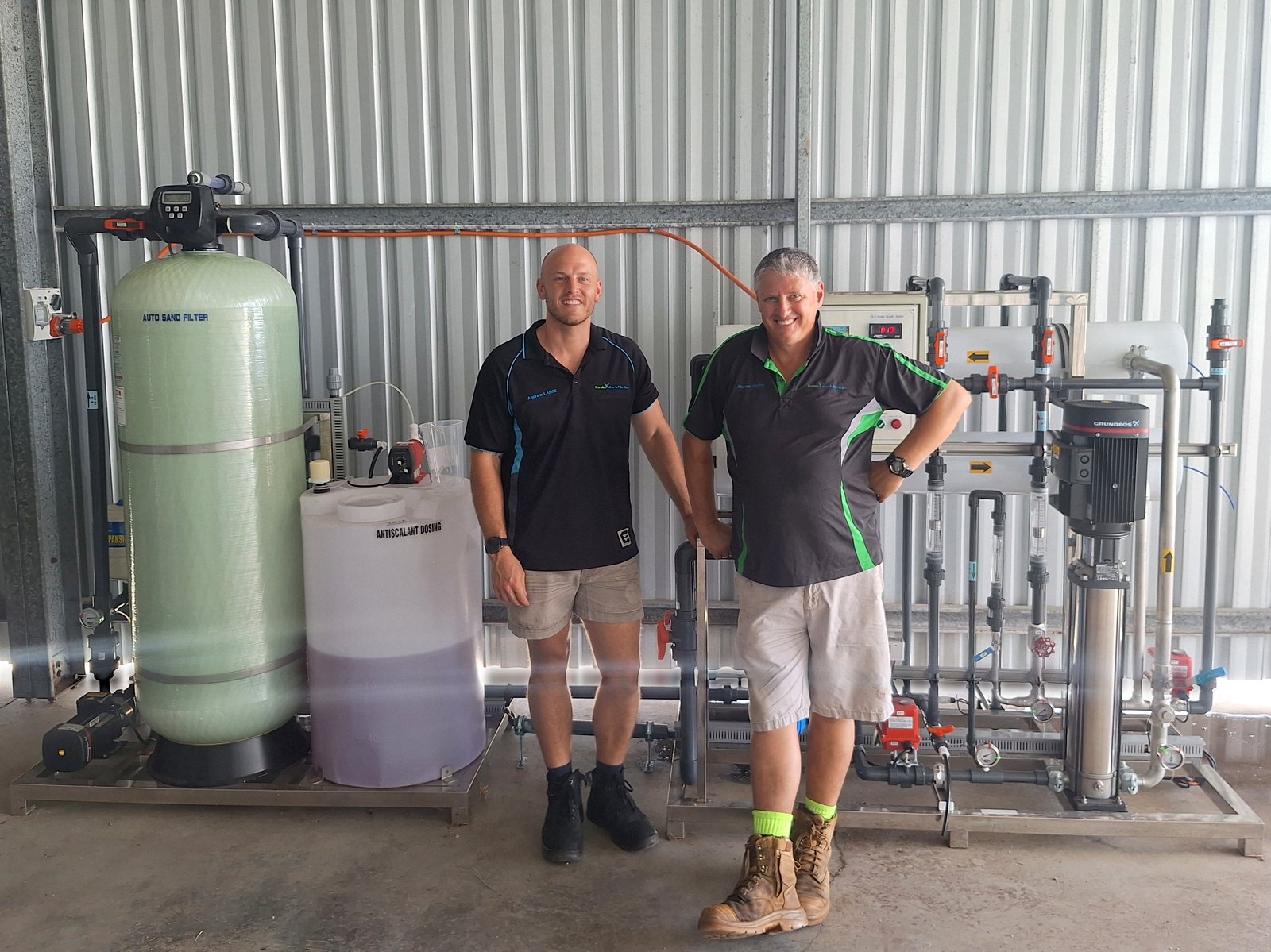
Built and wet-tested in Townsville
Servicing, filters and spares
Bore water treatment systems that make bore water safe and usable for drinking, stock, irrigation and process water.
Bore water is often cheaper than town water, but it rarely comes out of the ground ready to use. Depending on the aquifer it can carry iron and manganese that stain, hardness and silica that scale pipes and equipment, salt that corrodes and tastes brackish, and bacteria that make it unsafe to drink. We provide bore water treatment in Townsville and across North Queensland: we test your water first, then design, build and service a system to suit, from a single homestead to a containerised plant for a mine camp.
Prefer to talk it through? Call (07) 4774 3607
Common bore water problems we treat
Iron and manganese Orange or black staining, a metallic taste and blocked fittings.
Hardness and silica White scale on taps, hot water systems, cooling towers and boilers.
Salt (high TDS) Brackish taste, corrosion, and water that can harm crops and stock.
Heavy metals, arsenic, fluoride and nitrate Health risks you can only find by testing.
Bacteria such as E. coli Unsafe to drink until the water is disinfected.
Sediment, colour and odour Cloudy water and rotten-egg smells from hydrogen sulphide.
Bore water treatment
What your filter catches
Switch treatment stages on and off to see what each one does to typical bore water: what gets caught in each cartridge, what goes down the drain, and what ends up in your glass.
About bore water
Explore your treatment stages
In your glass
Faint bar: before. Solid: after. Tap a row for details and to track it.
The five stages
Who catches what
Levels shown for each source are typical patterns, not a test of your water. Bores and dams in particular vary a lot between properties, so get a lab test before buying equipment.
Removal depends on the product. Carbon results assume a good-quality carbon block; chloramine needs catalytic carbon. Sediment only catches parasites at 1 micron absolute rating. RO removes most germs but is not relied on as a disinfection step. Look for WaterMark and AS/NZS 4348 certified products.
Maintenance intervals are typical ranges; follow the manufacturer’s schedule.
Which bore water treatment system fits your site?
Homes and homesteads
Single household
Best for
Rural homes and homesteads that need clean, stain-free water through the house and safe drinking water at the tap.
Typical setup
Sediment filter, iron or softening filter, UV disinfection and a cabinet reverse osmosis unit.
Farms, caravan parks and camps
2,500 to 50,000 L/day
Best for
Drinking water for guests, workers and staff, plus stock water and washdown.
Typical setup
Pre-filtration, a reverse osmosis skid, disinfection and treated water storage.
Mines, industry and aquaculture
50,000 L/d to over 1 ML/d
Best for
Mine camp drinking water, process and boiler feed water, and aquaculture supply.
Typical setup
Skid-mounted or containerised reverse osmosis plant, with ion exchange where needed. Hire available.
Not sure which fits? Send us your bore water analysis and we will recommend a system.
How we treat your bore water
Test your bore water
We arrange testing through a NATA-accredited laboratory, or review the results you already have. Request testing.
Design the system
Each treatment stage is chosen to suit your results, flow rate and how the water will be used.
Build and wet-test
Assembled and pressure-tested in our Townsville workshop before it leaves.
Install and commission
Installed and commissioned on site, with treated water checked against your target quality.
Service and support
Filter and membrane changes, servicing and spares from Townsville.
Bore water treatment FAQs
Is bore water safe to drink?
Not without testing. Bore water can contain bacteria, nitrate, arsenic, fluoride or heavy metals that you cannot see, taste or smell. Test it against the Australian Drinking Water Guidelines before drinking it, and treat it if it falls short.
How do I get my bore water tested?
Contact us to arrange sampling and lab testing, or send us results you already have. See our water testing page.
What causes orange staining from bore water?
Usually iron, and black staining is usually manganese. Both dissolve in groundwater and turn into rust-coloured or black particles once the water meets air. Oxidation followed by filtration usually removes them.
Will a water softener fix hard bore water?
A softener removes calcium and magnesium hardness, but not salt, silica or most other contaminants. If your bore water is also salty, reverse osmosis is usually the better fit.
Can bore water supply a mine camp or caravan park?
Yes, once it is treated to meet the Australian Drinking Water Guidelines. A typical system is pre-filtration, reverse osmosis and disinfection, sized to your daily demand. Commercial and public supplies can have extra obligations under Queensland drinking water law, so check yours with the regulator.
How much does a bore water treatment system cost?
It depends on your water quality and how much water you need each day. We quote after reviewing a water analysis, so you only pay for the treatment stages your water needs.
Can you fix or upgrade an existing bore water system?
Yes. We service, repair and upgrade existing systems, including ones we did not install, to lift capacity or water quality.
Do you work outside Townsville?
Yes. We are based in Townsville, work across North Queensland including Mount Isa, Mackay and Cairns, and supply systems Australia-wide.
Tell us about your bore water
Send us your water analysis, or ask us to test your bore. Tell us your daily volume and what the water is for, and we will recommend a system. The review and recommendation are obligation-free.